
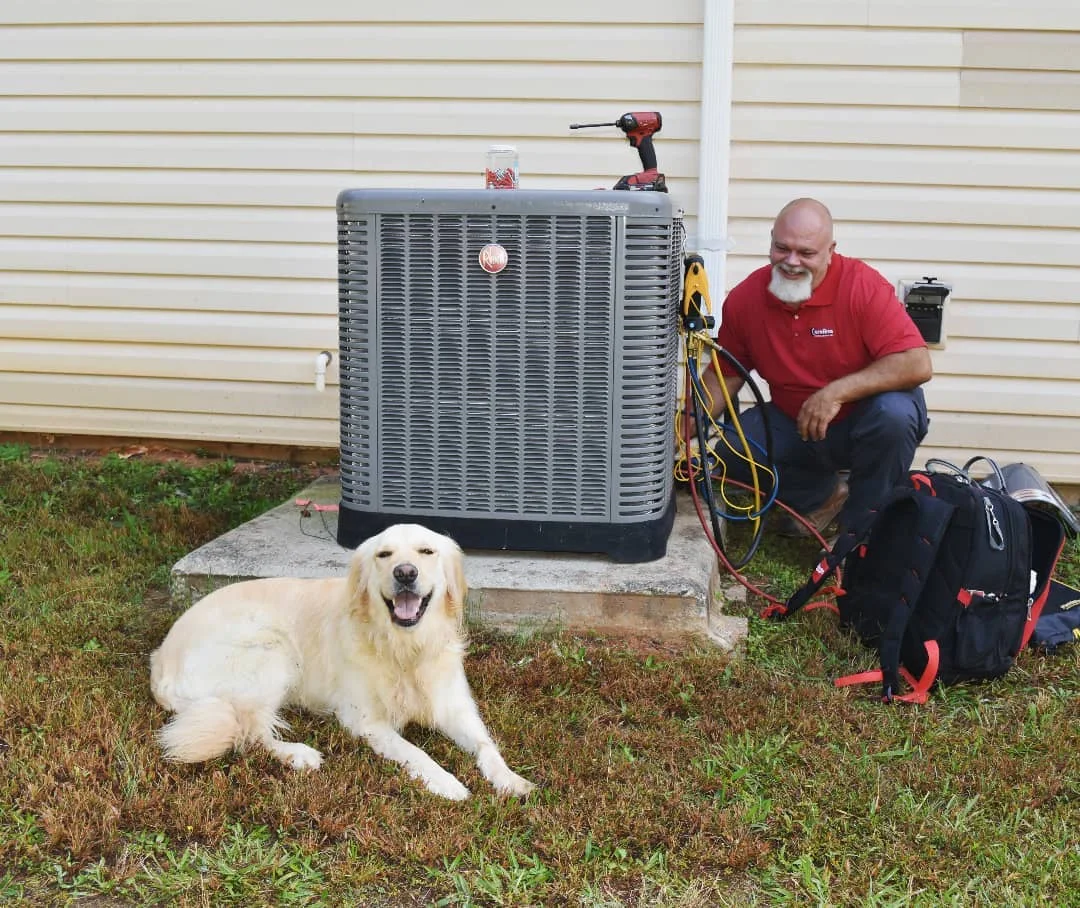
By the time the pool opens and the grill is clean, an Upstate air conditioner is about to be asked to run every day until October. The first heat wave in Greenville tends to arrive before Memorial Day. Getting the system ready does not take a whole weekend, only a little of four of them. So this post lays out one short task for each weekend in May, ending with the one that belongs to a technician. Do them in order and the system will be ready before the first 95-degree afternoon.
The first weekend, indoors at the filter
Start indoors by replacing the filter, which after an Upstate spring is loaded with pollen, and set a reminder for the first of each month through October. Then set the thermostat to cool and five degrees below the room temperature, let the system run for twenty minutes, and hold a thermometer at a supply vent and another at a return grille. On a healthy system the vent air runs about 15 to 20 degrees cooler than the return air. A smaller difference on a system that is otherwise running points to a dirty coil, a low charge, or a compressor losing capacity, and that is worth noting for the fourth weekend. Cool air at the vents with a warm house points to the ducts.
Weekend two, outside at the unit
Move outside and clear leaves, pine straw, and shrubs two feet back from the outdoor unit on every side, and rinse the coil gently with a garden hose, from the inside out if the cabinet allows, without a pressure washer, until the yellow-green pollen film is gone. Then have someone start the system while you stand beside the unit and listen. Both the fan and the compressor should come on together within a second or two, with a steady hum. A hum before the fan catches, a click that repeats, or a start on the second try is a capacitor or contactor near the end of its life, and either is an inexpensive part in May and a compressor in August. Look at the disconnect box on the wall for damage or insect nests.
Then the drain and the attic
Back indoors, find the air handler. With the system running on a humid afternoon, look at the condensate line where it exits the house or at the pan beneath the indoor unit; water should be dripping steadily from the drain. A dry drain on a running system means the line is blocked with the algae that Upstate humidity grows every summer and the water is going into the pan, and a full pan trips the float switch on the first hot day or, without one, comes through the ceiling. For an attic air handler, check the ceiling beneath it for stains, and note anything you find for the fourth weekend, and read the manufacture date on the outdoor unit’s nameplate while you are at it, since a system past twelve years with a failed test above is a candidate for a replacement plan rather than another repair.
And on the last weekend, the technician
The three weekends above tell you whether the system runs. The fourth tells you whether it will keep running through October, and it is the one that needs instruments. A spring tune-up measures the refrigerant pressures and temperatures that show whether the charge is right, tests the capacitor and contactor under load, reads the compressor’s current draw, cleans the indoor and outdoor coils, clears and treats the drain, confirms the float switch, and measures airflow through the ducts. Each reading goes on a system report card beside the specification, the visit is recorded on video, and if you noted a small temperature split, a hum, or a dry drain on the earlier weekends, the technician has somewhere to start.
Reading what the four weekends found
- Every test passed and the report card is clean: change the filter monthly through October and put next spring’s visit on the calendar.
- One or two tests failed and the system is under twelve years old: have the repair done now, while the part is small and the schedule is open.
- Two or more tests failed and the system is past twelve years: ask for both a repair price and a replacement price, and take your time with them. A new system from Carolina Heating Service carries a 10-year parts and labor warranty, and May is the month to decide calmly.
Why May rather than June
The first hot week of a Greenville summer fills every schedule in the Upstate on the same afternoon, and it is when a system that limped through May finally quits. Doing the four weekends in May means the appointment is convenient, the parts are in stock, and if a replacement is coming, there is time to compare rather than take what can be installed soonest. Members of the Carolina Comfort Club receive priority service when the season turns, along with the spring visit itself as part of the plan.
Booking the fourth weekend
Carolina Heating Service has served Greenville and the Upstate since 1981. Schedule the technician’s visit online or through the 24/7 website chat, and you will receive a photo of your technician and an on-the-way message before arrival. If a test on an earlier weekend failed, same-day repair service is available by phone, and any repair comes with the price presented before the work and a one-year workmanship warranty.