
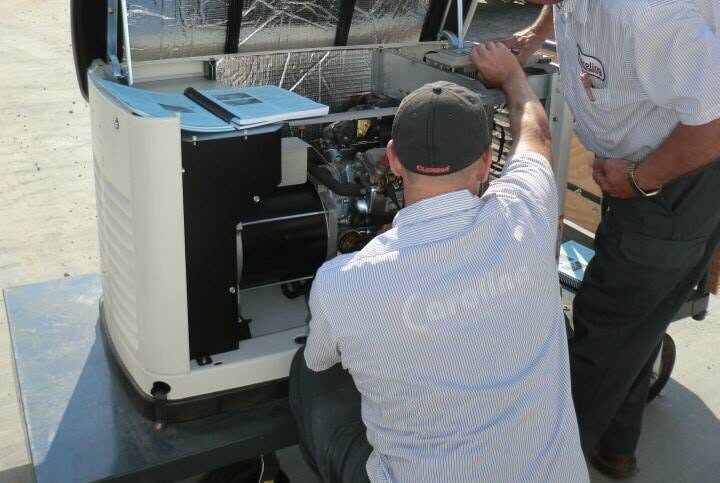
A whole-home generator senses the loss of utility power and switches the house onto generator power on its own. The case for one in the Upstate usually comes down to how often the grid has already let a household down, and what those outages cost in comfort, safety, and spoiled food. Greenville loses power to three different kinds of weather, and each does something different to a house. This post takes them one at a time and explains what a generator protects in each. It then covers who benefits most and what installation involves.
Winter ice
Ice is the Upstate’s particular winter problem, since a quarter inch of it adds hundreds of pounds to a tree limb and to the line beneath it, and the ice storms of December 2005 and February 2014 each left large parts of Greenville and Spartanburg dark for days. When the power goes in an ice storm, the heat pump, the furnace, and the water heater all stop, and a house that started the night at 68 falls toward the outdoor temperature by morning. For an older adult or an infant, a house in the 40s is a health matter rather than a discomfort, and a whole-home generator carries the heating system through the outage without anyone going outside in the ice to start it.
Summer thunderstorms
Summer afternoons in the Upstate produce thunderstorms most weeks, and the wind and lightning take down lines for hours at a time on the hottest days of the year, when a closed house without cooling climbs into the upper 80s within hours. The outage itself is often short, but the restoration is rarely clean; power returns in flickers that strain compressors and burn out capacitors and control boards across a neighborhood. A generator connected through an automatic transfer switch takes the house off the grid cleanly when the power drops and returns it cleanly when stable power is back, so the equipment sees one clean transfer each way, and the house stays cool in between.
Tropical remnants
Greenville is a long way from the coast, and Helene in 2024 showed that distance is not protection. The remnants of that storm crossed the Upstate with wind and rain that put trees on lines across the region, and hundreds of thousands of homes were dark, many for a week or more. A week without power is a different problem from a night. Refrigerators and freezers are lost by the second day, well pumps in rural Greenville, Anderson, and Laurens counties deliver no water, sump pumps sit idle while crawl spaces fill, and households with medical equipment are making hard decisions. A whole-home generator on natural gas or propane runs for the duration of an outage like that, with no gasoline to find at stations that have lost power too.
What the generator protects, whatever the weather
- Heating and cooling equipment, so the home stays at a safe temperature in either season.
- Refrigeration, so food and refrigerated medication are not lost.
- Sump pumps and well pumps, which are needed most during the storms most likely to cause the outage.
- Medical equipment that depends on continuous power, such as oxygen concentrators and CPAP machines.
- Security systems, garage doors, phones, and the router, which keep the household connected and working.
Why automatic matters
The difference between a whole-home generator and a portable one is what happens when nobody is home. A portable unit must be rolled out, fueled, started by hand, connected with cords, kept well away from the house because of carbon monoxide, and refueled every several hours, and it cannot run central heating or cooling in most homes. A standby unit is permanently installed, wired into the panel through a transfer switch, and starts on its own within seconds of an outage, then shuts itself down when utility power returns, whether the household is asleep, at work, or out of town.
Who benefits most
The households for whom a generator stops being a luxury are easy to describe. Anyone who depends on powered medical equipment or refrigerated medication. Households with an infant or an older adult who cannot tolerate a hot house in August or a cold one in January. Homes on wells, which lose water with the power. Homes over a crawl space with a sump pump, since the storm that fills the space cuts the pump’s power. Anyone who works from home and loses income for every day the power is out, and any household that has sat through two multi-day outages in five years, because that is a pattern rather than bad luck.
What installation involves
A whole-home generator is sized to the house, and the technician totals the loads from the equipment nameplates, including the heat pump and its auxiliary strips, which draw several times what the air conditioner does in summer, and recommends a unit that carries them, sometimes with a load management module that sheds the largest loads when the generator nears capacity. The installation includes the unit on its pad, the transfer switch and any panel work, and the fuel connection, gas line or propane tank. Because Carolina Heating Service handles the electrical work as well, the whole job runs under one contract. Installation requires a permit and an inspection and takes weeks rather than days, so fall and winter are the practical seasons to plan one, and financing is available.
Talking it through
Carolina Heating Service has served Greenville and the Upstate since 1981 and installs and services whole-home generators across the region. If one of the three kinds of outage above has already visited your house, the useful next step is an in-home consultation, in which a technician reviews your outage history, your equipment, and your fuel options and presents a firm price before anything is scheduled. Schedule it online or through the 24/7 website chat, and the decision will be yours to make before the next storm rather than during it.