
Every visit from Carolina Heating Service is recorded on video. The spring tune-up is the visit where that recording answers the most common question we hear, which is what a technician does for an hour on a system that seems to be working. So this post walks through a spring tune-up the way you would see it on the video, from the first reading to the last. It explains why each step matters before a Greenville cooling season that runs from April into October. By the end, the case for the visit should be as plain as the footage.
The first minutes, at the thermostat and the filter
The video opens indoors. The technician sets the thermostat to cool and checks its calibration against a reference thermometer, because a thermostat that reads two degrees off runs the system two degrees longer all summer. The filter comes out next, and in an Upstate spring it is usually yellow with pollen, which is the first thing on the video most homeowners react to. A filter that loaded restricts airflow enough to freeze the indoor coil in the first warm spell, and the technician’s question about how often it is changed is not small talk.
At the indoor unit, the coil, the drain, and the blower
The next several minutes are at the air handler. The indoor coil carries a winter of dust and, in Upstate humidity, whatever grew on it during a damp fall, and the video shows it being cleaned, since a dirty coil is the most common reason a system cools without drying the air. The condensate drain is cleared and treated, and the technician pours water through to confirm it runs and that the float switch shuts the system down if it does not, which is the step that keeps an attic air handler’s pan from coming through a ceiling in July. The blower motor’s current draw is measured against its rating, and the static pressure across the ductwork is read, which is the number that shows whether a duct joint has separated in the attic.
At the outdoor unit, the readings a homeowner cannot take
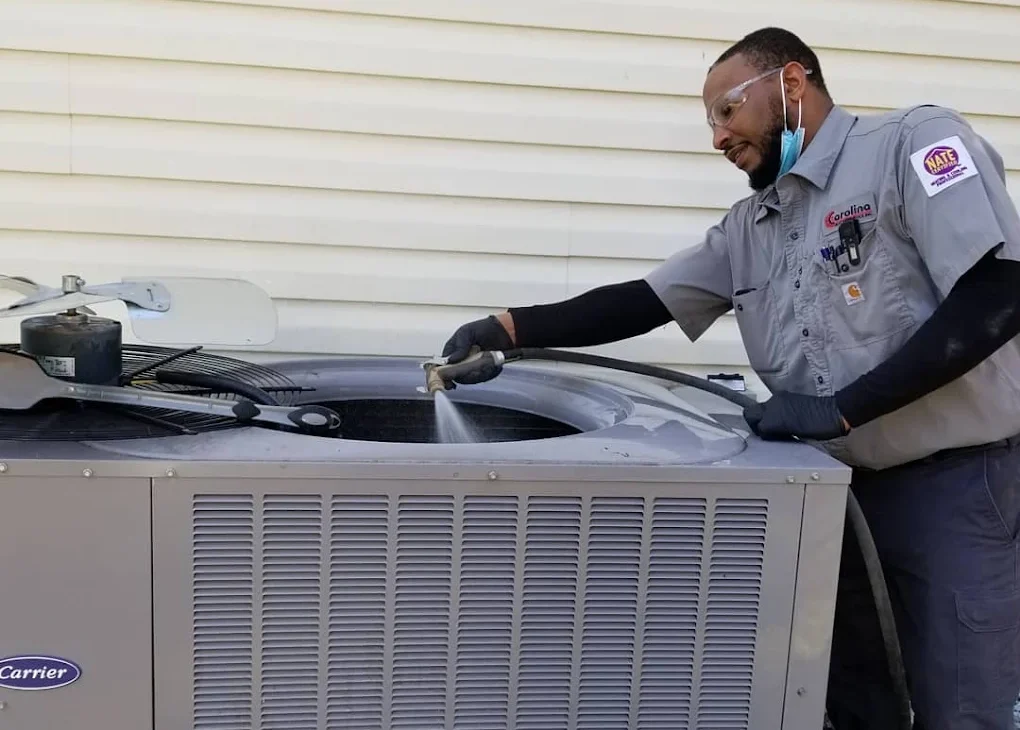
The longest section of the video is outdoors, and it is where the visit earns its cost. The technician removes the panel and puts a meter on the capacitor, reading its charge against the rating printed on its side; a capacitor drifting below that rating is the part that leaves an outdoor unit humming with the fan still on the first 95-degree day, and it is inexpensive in April. The contactor’s contacts are inspected for pitting, the connections are cleaned and tightened, since a season of vibration loosens them and a loose connection builds heat, and the compressor’s starting and running current are measured. Then the gauges go on the refrigerant lines, and the pressures and temperatures tell whether the charge is correct or whether a slow leak has started, which cannot be judged by feel. Last, the coil is cleaned of the pollen film that blocks the airflow it needs to shed heat, and the video shows the difference.
The last minutes, at the report card
The video ends with the technician filling in the system report card, one line per reading, each beside the manufacturer’s specification, and walking you through it. A visit on a healthy system ends with a card that says so and a few words about the filter. A visit that finds a capacitor at the edge of its range, or a charge a little low, ends with a plain explanation and the price of the repair presented before any work, and the decision about whether to act on it is yours. That card, and the video behind it, are also what a manufacturer asks for when a warranty claim comes up, since most makers require documented professional maintenance to honor one.
Why spring rather than the first hot week
Every homeowner in the Upstate discovers a cooling problem on the same afternoon, which is the first day the heat index passes 100, and that is the day every schedule in Greenville fills. A system that has run for weeks on a dirty coil, a low charge, and a weak capacitor is the system that quits that afternoon, and the parts that were inexpensive in April are a compressor in July. A tune-up in March or April is a convenient appointment on a mild day, with time to order a part or compare quotes if the readings say a replacement is coming. Members of the Carolina Comfort Club receive two tune-ups a year with priority service, which is how the spring visit stays in spring.
What the video is for
The recording is not a formality. It is how a homeowner who was at work during the visit can see the pollen on the filter, the reading on the capacitor, and the coil before and after, and it is how a recommendation comes with evidence rather than a description. Every technician at Carolina Heating Service completes a multi-month training program at hire, and the video is how that training shows.
Scheduling the visit
Carolina Heating Service has served Greenville and the Upstate since 1981. Schedule a spring maintenance visit online or through the 24/7 website chat, and you will receive a photo of your technician and an on-the-way message before arrival. The visit takes about an hour, and you will have the video and the report card when it is done.