
Not every leak shows up as a puddle. Some run behind a wall, under a slab, or in a crawl space for months. Greenville’s humid summers make the usual clues easier to miss, since a little extra dampness in the air is easy to write off as the season. The good news is that a homeowner already owns four tools for finding a hidden leak, and none requires opening a wall. This post walks through each one, the water bill, the meter, your nose, and your hand. It then covers what a professional adds when the four tools say a leak is there but not where.
Start with the water bill
If the household’s habits have not changed but the water bill has crept up over two or three billing cycles, a leak is one of the more common explanations. It does not take a burst pipe to move the number; a supply line or a fixture running continuously somewhere you cannot see does it. Set the bills side by side and look at the gallons rather than the dollars, since rates change and gallons do not. A running toilet, the most common hidden leak of all, can move that number more than most people expect, and the fix is a fill valve or a flapper. For homes on wells in rural Greenville, Anderson, and Laurens counties, the bill is the electric one, and a well pump that runs when nobody is using water is the same clue.
Then the water meter
The meter turns a suspicion into a fact. Turn off every faucet, appliance, and irrigation zone in the house, find the meter near the street, and write down the reading. Wait about twenty minutes without using any water, and read it again. If the number has moved, water is leaving the system somewhere, even if you cannot see or hear it. Many meters also have a small leak indicator, a tiny wheel or dial that spins when any water at all is flowing, and watching it for a minute with everything off gives you an answer without waiting. A meter that moves with the main shutoff closed points to a leak in the line between the meter and the house, which in Upstate yards means a break in a water line under red clay that may never show on the surface.
Tool three, your nose
A musty smell that lingers in one room, or shows up near a closet or a bathroom wall, usually means moisture is sitting somewhere it cannot dry out. That is a harder smell to place in Greenville than in a drier city, because humid summer air already carries some dampness of its own, but a smell that is stronger in one specific spot and does not fade with the weather is usually a leak inside a wall cavity, well before any staining reaches the surface. Mold follows moisture within days in this climate, so a smell that will not go away is worth tracking down rather than airing out. A sewer smell is a different clue, pointing to a dry trap or a cracked drain line, and it belongs to the plumber too.
And finally your hand
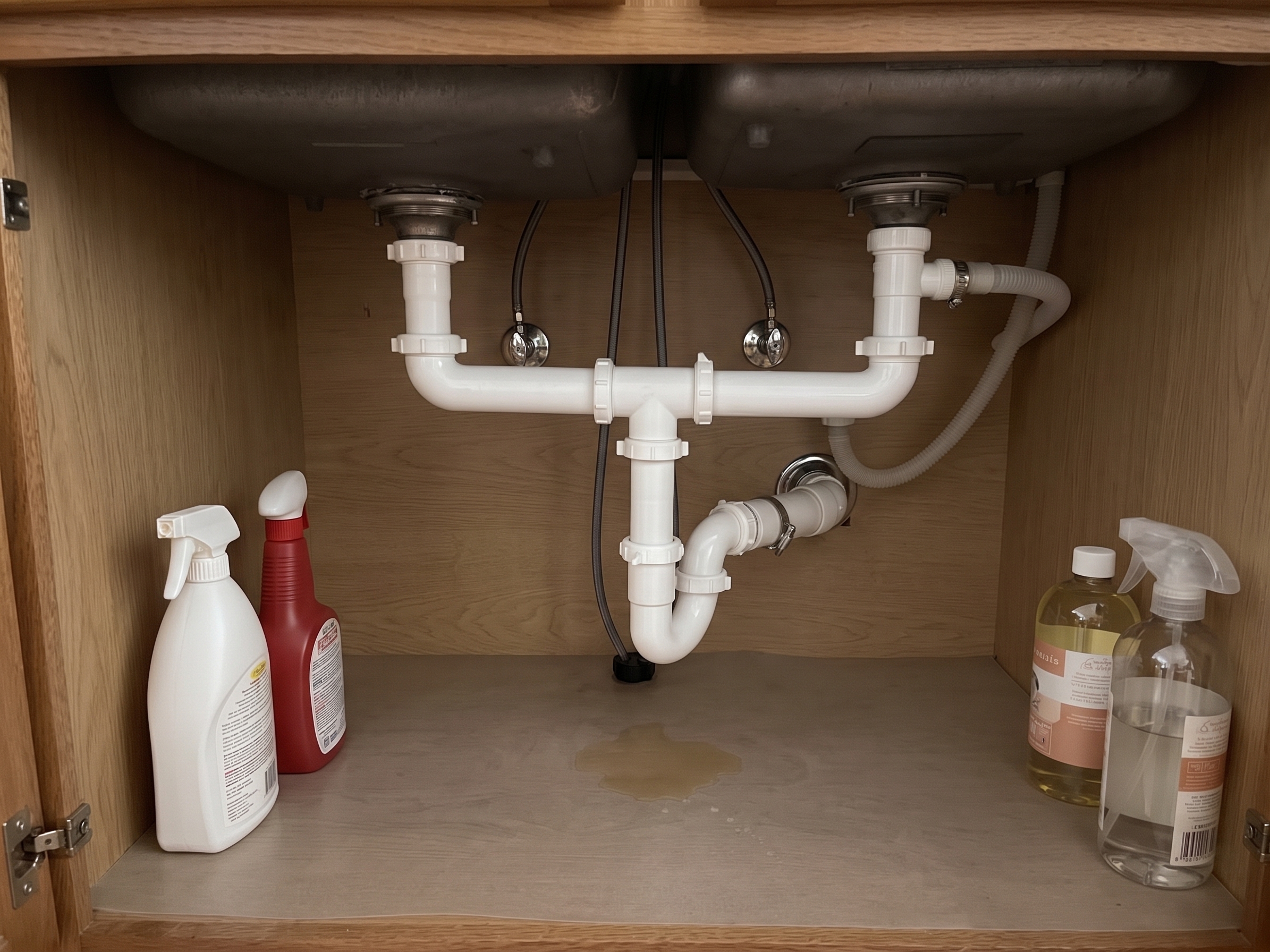
Touch finds what eyes miss, and a floor that feels warm in one spot, on a slab home, means a hot water line leaking beneath it, and Greenville’s slab-built ranches from the 1960s and 1970s have that pattern. A soft spot in a floor, or a cabinet floor under a sink that gives slightly, means water has been reaching it for a while. Drywall that feels cool or damp to the back of a hand, paint that bubbles, or a baseboard that has begun to separate from the wall all mark where water is sitting behind them. Open every cabinet under a sink and run your hand along the supply lines and the trap, since a fitting can weep for months without dripping enough to pool.
What the four tools cannot tell you
Together, the four tools can confirm that a leak exists and roughly where it is. They cannot tell you which pipe, or whether the leak is a fitting, a pinhole, or a failing run of older pipe, which is the difference between a small repair and a repipe, and that is where whole-home leak detection comes in. A technician uses acoustic equipment, thermal imaging, and pressure testing to locate the leak to a specific spot before anything is opened, so the wall or floor is cut once, in the right place, rather than room by room. Our water line team handles the line between the meter and the house, and a camera inspection covers the drain side.
Why hidden leaks matter more here
Greenville’s climate does two things to a hidden leak. The humidity hides it, masking the smell and the dampness that would give it away in a drier place, so it runs longer before anyone notices. And the humidity feeds what follows it, since mold establishes in wet framing and drywall within days, which turns a plumbing repair into a remediation job. The four tools above are worth using once a season for that reason, and the meter test in particular takes twenty minutes and a pencil.
When the tools say yes
Carolina Heating Service has served Greenville and the surrounding Upstate since 1981. If the bill has climbed, the meter moves with everything off, a room smells musty in one spot, or a floor feels warm or soft, schedule a leak detection visit online or through the 24/7 website chat, and same-day repair service is available by phone. The technician will locate the leak, show you what was found on video, and present the price before any wall is opened, and members of the Carolina Comfort Club receive priority service and member pricing on the repair.