
The Upstate sees severe thunderstorms, the occasional tornado, ice storms, and the remnants of tropical systems that move inland, and any of them can take the power for hours or days. Once the lights come back on, it is worth a closer look before assuming everything is fine. Surges, long outages, and storm damage affect systems in ways that are not obvious the first day. Carolina Heating Service sends four kinds of technician into homes after a storm, and each has a list. Here are all four, with the items you can check yourself first.
What the electrician checks
Start at the breaker panel. Reset any breaker that tripped during the outage one at a time, and watch for one that trips again immediately, which points to a fault on that circuit rather than a simple reset, and should stay off until an electrician has looked. Look at outlets and switches for scorching, melted plastic, or a burning smell, and treat any of those as a reason to stop and call. If the home has whole-home surge protection at the panel, a strong surge during the storm is exactly the event it was built to absorb, and doing its job can mean it needs to be reset or replaced afterward; check its indicator light, and if it shows a fault or is not lit, have it inspected before the next storm. Several dead electronics at once mean a surge came through, and that is the signal to have the panel and the heating and cooling system looked at even when they seem fine.
The HVAC technician’s restart checks
Give the system a few minutes before judging it, since most have a built-in delay so the compressor does not restart under pressure. Then listen for a steady hum with the outdoor fan turning, which is what you want, because a hum with no fan, a click that repeats, or a unit that starts and stops within a minute points to a capacitor, contactor, or control board that took a hit during the restoration flicker, and those are the most common calls we take in the days after a storm. If the outdoor unit does not start at all, do not keep trying to force it, because a strained compressor is damaged by every attempt. If the system runs but fails to reach the set temperature over the next hour, or cycles more than it used to, a surge may have damaged a component even though the unit appears to work. Our air conditioning and heating technicians begin with the electrical readings, since that is usually where the answer is.
On the plumber’s side, the water
An electric water heater usually comes back on its own, though some units have a high-limit reset that trips after a power event; if there is still no hot water an hour later, let a technician check it rather than opening the access panel yourself. Give the tank an hour to recover, and glance at the floor around its base, because the pressure swings of an outage can turn a small drip into a puddle. If your home is on a well, run a cold tap for a minute or two once the pump has power; air in the lines is normal and clears, but pressure that will not build means the tank or the switch needs attention. If you have a sump pump, it sat idle while the storm dumped rain on the clay around the house, so the pit may be full; lift the float or pour water in to confirm it runs, and if it does not, our sump pump team should see it soon.
For the generator technician, the run it just finished
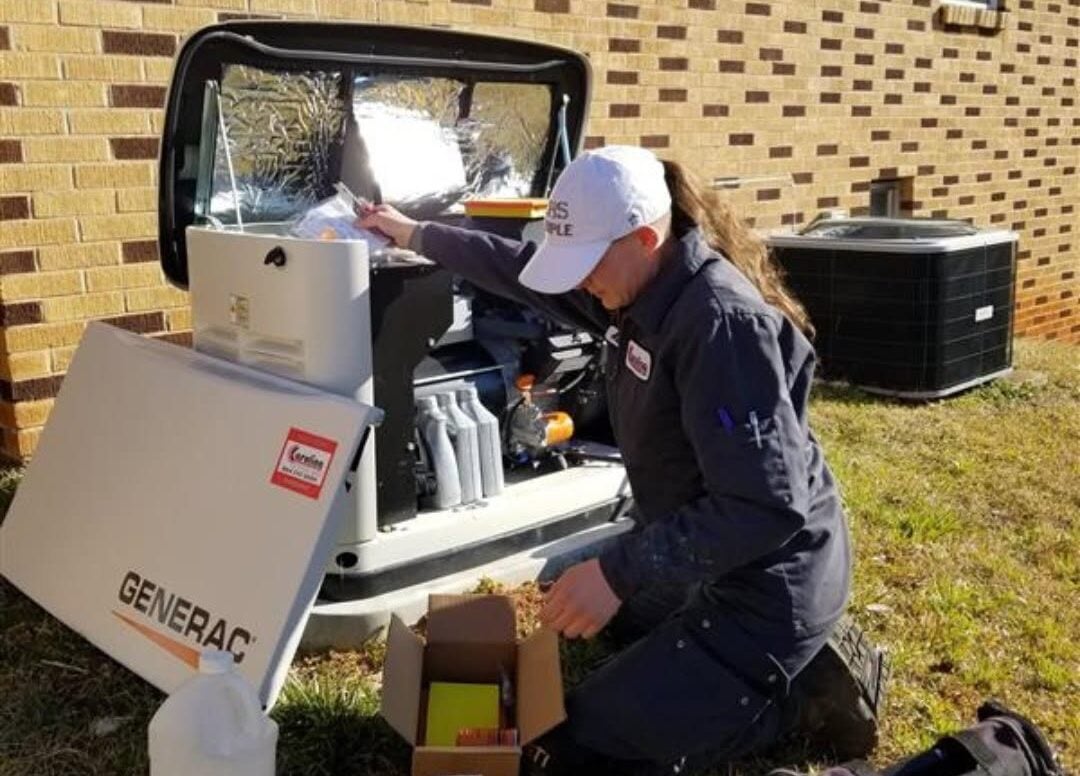
A standby generator handles the return to utility power on its own, running a short cooldown and settling back to standby, but it cannot service itself. Note the hours it ran, check the controller for any logged fault, and look under the enclosure for oil. A generator that ran for more than a day or two has used up a good share of the interval between oil changes and should have generator service before the next storm rather than at the next yearly visit. A portable generator should be cooled and stored with the fuel treated or drained, since stale gasoline is the usual reason a portable will not start next time.
And the refrigerator, which belongs to everyone
USDA guidance is simple: a refrigerator holds a safe temperature for about four hours with the door closed, and a full freezer for about 48 hours, or 24 if half full. Anything in the refrigerator that spent longer than four hours above 40 degrees should go, and frozen food with ice crystals can be refrozen while fully thawed food should not be. It is also worth confirming the refrigerator restarted and is cooling as it should, since its control board is as vulnerable to a surge as any other.
Sorting what can wait
Most of what these four lists turn up will be fine, and the rest sorts into a few categories worth a call rather than a wait: a breaker that keeps tripping, a burning smell, a heating or cooling system that will not restart, water where it should not be, a well pump that will not build pressure, or a generator fault. A bent fin, a filter full of storm dust, and a spent surge protector can wait for a scheduled visit.
One call for all four lists
Carolina Heating Service has served Greenville and the Upstate since 1981 with heating, cooling, plumbing, electrical, and generator technicians under one roof, which after a storm means one call rather than four. Same-day repair service is available by phone, members of the Carolina Comfort Club receive priority service in the week after a storm, and every visit ends with a system report card and a video of what was found, so one call covers all four lists.