
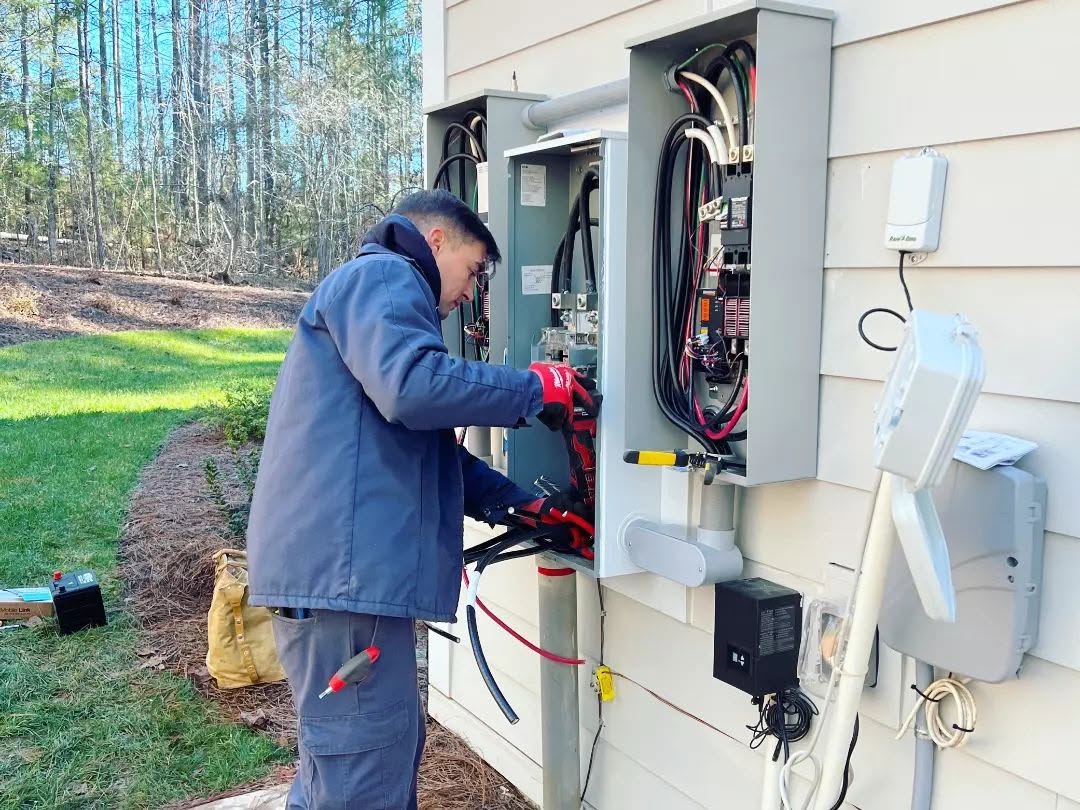
Today’s homes run more devices, appliances, and equipment than the panels installed a few decades ago were built to carry. When a panel cannot keep up, the result is nuisance breaker trips, dimming lights, and in some cases a fire risk behind a closed door. Panels get replaced for one of three reasons, and knowing which one describes yours makes the decision clearer. The panel is failing, the panel is full, or the panel is a kind that electricians no longer trust. Here is how to recognize each in an Upstate home, and what the upgrade involves.
1. The panel is failing
A failing panel announces itself. Breakers trip repeatedly even when the connected devices are not drawing anything unusual, or will not stay reset. The panel shows rust, scorch marks around a breaker, or a persistent burning smell, which means a connection inside is arcing and heating. A breaker feels warm, or the panel buzzes, and any one of these is a reason for an inspection this week; together they mean the panel is past the point where a single breaker replacement solves it. Greenville’s summer thunderstorms add a local cause, since a surge through an aging panel damages breakers so they no longer trip when they should, which is the dangerous direction to fail. Our circuit breaker technicians can tell a failing breaker from a failing panel.
2. The panel is full
A panel can be perfectly healthy and still be the wrong size for the house it serves. Homes across the Upstate built before the 1990s often carry 100-amp service, which was ample for a house with one air conditioner, a gas range, and no home office, and is not ample for the same house today. The signs are lights that dim when the air conditioner or the dryer starts, a panel with no open slots and several tandem breakers doubled into single spaces, and extension cords doing permanent duty because there are not enough circuits. Certain projects push a full panel past its rating: a new heat pump, an electric vehicle charger, a home addition, a kitchen renovation with new appliances, or a standby generator’s transfer switch. Planning the panel upgrade alongside one of those projects keeps the work on your schedule rather than a tripping breaker’s.
3. The panel is a kind electricians no longer trust
Some panels are replaced on sight. A fuse box rather than breakers dates the service to before the 1960s and is harder to reset safely and harder to service, and the fuses are easy to oversize by mistake. Several breaker panel brands manufactured from the 1960s through the 1980s have documented histories of breakers that fail to trip under a fault, and an electrician will recognize them by the label and the breaker style; a home inspector often flags them at a sale. If your panel is one of these, it is a candidate for replacement whether or not it has shown a symptom, and an electrical inspection will say so plainly.
What an upgraded panel improves
A new, higher-capacity panel does three things for a house. It removes the overloaded circuits and the heat that comes with them, which is the fire risk. It gives the house the capacity for the equipment it has now and the equipment it will add, from a heat pump with auxiliary strips to an EV charger, without tandem breakers and extension cords. And it puts modern protection in place, with arc-fault and ground-fault breakers where the code requires them and a whole-home surge protector at the panel, which in a region with the Upstate’s lightning is the least expensive insurance a house can carry.
What the upgrade involves
A panel upgrade is a permitted job with an inspection, and it takes most of a day. The electrician coordinates with the utility to disconnect service, removes the old panel, installs the new one with new breakers, reconnects and labels every circuit, corrects the grounding and bonding if they are short of current standards, and adds surge protection if you have chosen it. Power is off for several hours during the work, so it is planned for a day that suits the household. Every technician at Carolina Heating Service completes a multi-month training program at hire, the price is presented before any work begins, the job is recorded on video, and it carries a one-year workmanship warranty with callbacks free within 30 days.
Finding out which reason is yours
Carolina Heating Service has served Greenville and the Upstate since 1981. If your panel is showing signs of the first reason, call this week. If it is full, or you are planning a project that will fill it, or you suspect it is one of the types described above, schedule an electrical inspection online or through the 24/7 website chat. The electrician will open the panel, tell you plainly which reason applies and whether the answer is a breaker, a subpanel, or a replacement, and leave the decision with you. Financing is available, and members of the Carolina Comfort Club receive priority service.