
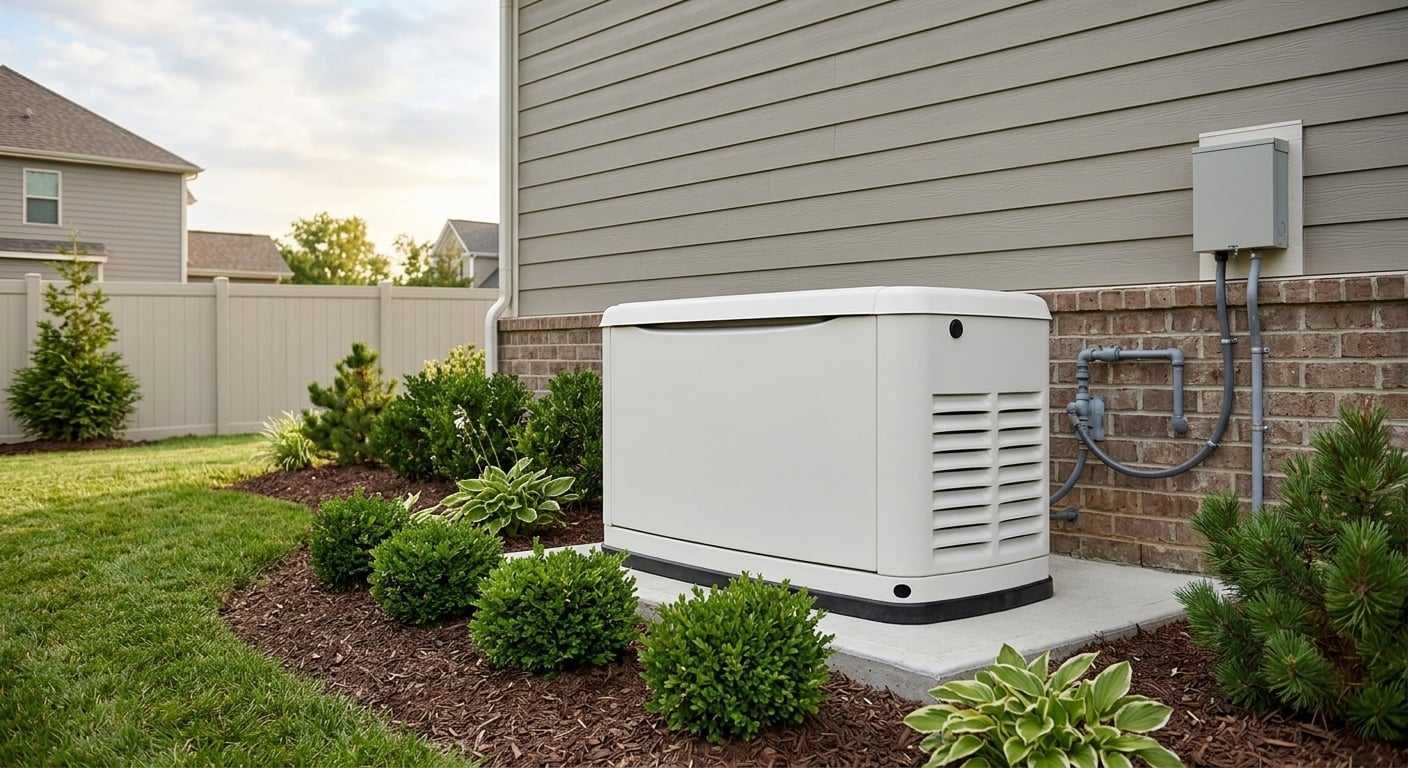
A standby generator in the Upstate spends the winter running a short self-test once a week and otherwise waiting. Spring is when it should be looked at, because the thunderstorm season that begins in May and the tropical remnants that can arrive in September are what it exists for. The simplest spring checklist is also the most useful: find out when the generator is set to exercise, stand beside it, and watch one full cycle from start to shutdown. Nearly everything a homeowner can check shows itself in those fifteen minutes.
Before it starts, the enclosure and the controller
Arrive a few minutes early and look at the unit at rest. The controller’s status light should be green, since yellow or amber means maintenance is due or a minor fault is logged, and red means a fault that will keep the unit from starting at all. Look at the pad beneath the enclosure for oil or coolant stains, which mean a leak that a long run will turn into an engine problem. Look at the louvers for pine straw, leaves, and the wasp nests that Upstate springs produce, and at the clearance around the unit, since shrubs close in over a season and the generator needs that space to breathe. If the unit runs on propane, read the tank gauge, which should be above half heading into storm season.
The start, in the first three seconds
When the exercise begins, listen to the start. The engine should crank briefly and catch within a second or two. A slow crank, several seconds of cranking, or a start on the second or third attempt is a battery losing strength, and generator batteries last two to four years, with the Upstate’s summer heat pushing them toward the short end. A crank with no catch points to fuel delivery or a spark plug, and a start followed by a stall points to a fuel regulator that has drifted. Any of these is the most important finding of the afternoon, because a generator that struggles to start in a quiet self-test will not start in a storm.
The run, over the next several minutes
Once the engine settles, listen to how it runs, because the sound should be steady, and surging up and down, running rough, or visible smoke from the exhaust point to the air filter, the spark plugs, the oil, or the fuel system, and each gets worse under the full load of an outage than under the light load of a self-test. Walk around the enclosure while it runs and look again for anything dripping. Note how long the run lasts, and if the exercise seems shorter than it used to be, the controller may have been reset or reprogrammed, and if you cannot remember hearing it run at all in recent weeks, that is the single most important item on this list, because a unit that has stopped exercising has stopped being ready.
The shutdown, and what did not happen
The engine should shut down cleanly and the controller should return to green. Note one thing that did not happen during the self-test, which is that the transfer switch did not move. A weekly exercise runs the engine without transferring the house to generator power, so the self-test proves the engine will start and run, and it proves nothing about whether the switch will hand the house over when the utility fails, and that is the gap the yearly service covers.
What the yearly service adds
The self-test tells you the generator is alive. A generator maintenance visit tells you it will carry the house for days. The technician tests the battery under load, which is the only way to know it will turn a cold engine, and replaces it on schedule, then changes the oil and filter, replaces the air filter and spark plugs as needed, checks fuel pressure and the regulator, cleans and tightens every connection, opens the enclosure and clears whatever moved in over the winter, reads the controller’s fault log, inspects the transfer switch and its contacts, and runs the unit under a full load, which is the test the self-test cannot perform. It is also the moment to ask whether the unit still fits the house, since a heat pump or an EV charger added since the installation may draw more than the generator was sized for.
If you rely on a portable generator
A portable unit needs its own spring routine, because its usual failure is fuel. Drain or treat the gasoline that sat over the winter, since stale fuel leaves varnish in the carburetor and is the most common reason a portable will not start, and run the unit for fifteen minutes under a small load. Check the oil, replace a spark plug that has seen several seasons, and confirm the cords you plan to use are outdoor rated and undamaged. Then decide now where it will run in a storm, well away from every window and door, because carbon monoxide from portable generators takes lives every storm season, and never plug one into a wall outlet, which sends power back into lines where crews are working.
Why spring
Severe thunderstorms arrive in the Upstate in May, and the remnants of tropical systems follow from August into October; Helene in 2024 asked generators across Greenville to run for a week or more. A service visit in March or April means the unit has been load-tested before any of that, on a quiet day rather than the week a storm is in the forecast. Carolina Heating Service has served Greenville and the Upstate since 1981 and installs and services standby generators across the region. Schedule the spring visit online or through the 24/7 website chat, and members of the Carolina Comfort Club receive priority service when the season turns.