
Water heaters rarely fail out of nowhere if you’re aware of the symptoms to watch for. A handful of signs show up in the weeks or months before a tank gives out, and most homeowners do not put them together until there is water on the garage floor. The signs are easier to catch when you know where each one appears, so this post is arranged that way. It moves from the water at the tap to the sound of the tank, then to the floor beneath it and the label on its side. For an Upstate home, where a tank often sits in a humid garage or crawl space and works year-round, each place has its own story.
In the water, rust from the hot tap only
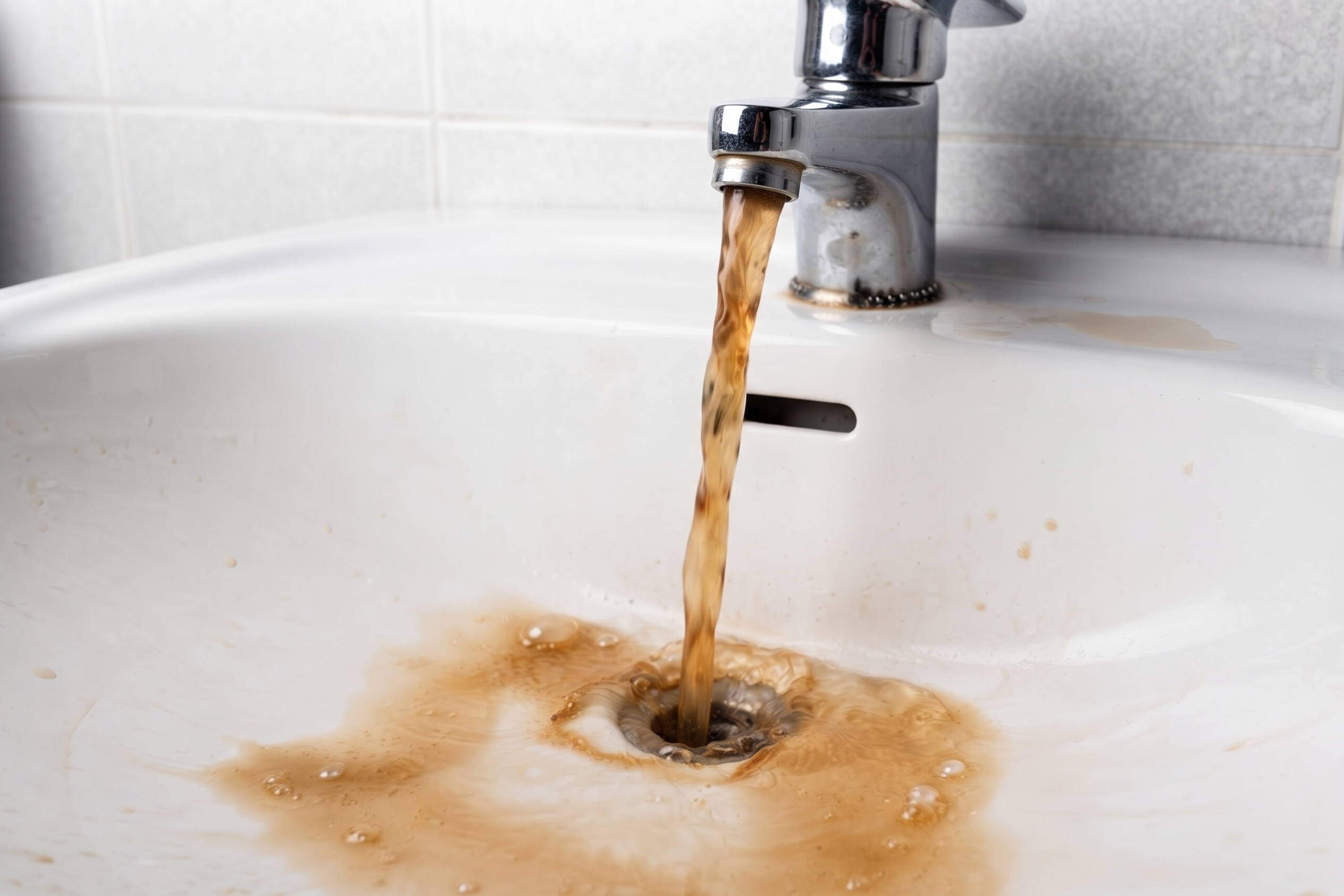
Run the hot and the cold at the same sink. If the hot water runs rusty and the cold runs clear, the rust is coming from inside the tank rather than from the pipes. A steel tank is protected by a glass lining and an anode rod, and once the lining wears through and the rod is spent, the metal beneath rusts and flakes into the water. Rust from both taps is a different problem, older supply pipe corroding, which our post on aging pipes by material covers; rust from the hot side alone is the tank telling you its age.
In the sound, popping and rumbling while it heats
A tank that pops, rumbles, or knocks while heating has sediment on the bottom, minerals settled out of the water over years. Water trapped under that layer boils and pushes through it, which is the noise. On its own it is not an emergency, but a tank working through an inch of sediment is working harder for the same hot water and losing years. A yearly flush through our water heater service clears it, and a tank that has never been flushed is carrying every year it has been in service.
At the shower, hot water that runs out sooner
If a shower that used to run twenty minutes now goes cold in ten, or the tank takes noticeably longer to recover between uses, the cause is usually sediment or a failing heating element rather than a change in how much hot water the household uses. In Greenville, hot water demand spikes during the handful of hard freezes each winter, when the incoming water is coldest and everyone reaches for the hot tap at once, and that is exactly when a struggling tank shows it. Tankless units show a similar pattern as scale builds inside the heat exchanger, and a yearly descaling is what prevents it. Either way, it is worth having someone look before the household is rationing showers.
On the floor, moisture or rust at the base
Water or rust-colored residue pooling around the bottom of the tank is the most serious sign on this list, because it usually means the tank itself has begun to leak rather than a fitting or a valve. A fitting can be tightened or replaced, and so can the relief valve, but a leak from the tank body cannot be repaired, and that tank needs replacing before it fails entirely, which on a full tank is forty or fifty gallons across the floor. A heater in an Upstate garage sits in humid air for months at a stretch, and that moisture works on the outside of the tank while sediment works on the inside, which is why tanks here tend toward the short end of their range.
On the label, the manufacture date
The last place to look is the label, which carries a manufacture date, sometimes plainly and sometimes coded into the serial number. A tank water heater lasts about 8 to 12 years, and a tankless unit about 20 with yearly maintenance. A tank past ten that shows any of the signs above is at its milestone, and one that shows none of them is still worth a plan, because the failure it is heading toward is a leak rather than a slow decline. Knowing the date turns the decision from a surprise on a holiday morning into a choice made on a quiet weekday.
It has never been flushed or serviced
A sign that appears nowhere on the tank is the service record. A heater that has never been flushed has years of sediment, an anode rod that is likely spent, and a relief valve that may not open when it should, and each of those shortens its life. A yearly flush and inspection checks all three, and it is the single thing that moves a tank from the short end of its range to the long one. Members of the Carolina Comfort Club have plumbing looked at as part of the plan, and a flush is a short visit on its own.
Repair, replace, or switch
Sediment, a failed element, a spent anode rod, and a leaking fitting are repairs on a tank with years left. Rust from the hot tap, a leak from the tank body, and a tank past twelve years are replacements. When replacement is the answer, it is also the moment to choose between another tank and a tankless unit, which hangs on the wall above the level floodwater reaches in a garage and lasts roughly twice as long, and our post on switching to a tankless water heater covers who should and who should not. Whichever you choose, the price is presented before the work and financing is available.
Before the floor decides
Carolina Heating Service has served Greenville and the Upstate since 1981. If your water heater is showing a sign from any of the places above, or has no service record, schedule a visit online or through the 24/7 website chat, and same-day repair service is available by phone. The technician will read the label, check the tank, and tell you plainly whether it needs a flush, a repair, or a plan, with the visit recorded on video.