
Some heating and cooling problems stay the same size while you decide what to do about them. The five below do not. Each one starts a chain, damaging the next component in line, and the longer the chain runs, the more the eventual repair includes. An Upstate cooling season from April into October gives the chain more hours than most places do. So this post takes each of the five problems and follows it link by link: what it looks like at the start, what it damages next, and the point where a technician can stop it.
1. A refrigerant leak
It starts as a slow loss of charge from a pinhole in a coil or a fitting, and the only sign is a system that takes a little longer to cool the house. What it damages next is the compressor, which is designed to run at a specific pressure and works harder and hotter at a low one, and the indoor coil, which drops below freezing on a low charge and ices over, blocking airflow and freezing further. Left long enough, the chain ends with a compressor that has run hot for a season and fails, which is the most expensive part in the system. A technician stops the chain by finding the leak with a detector or dye, repairing it, and restoring the charge to specification, and the readings on the report card show whether the compressor came through.
2. A clogged filter and restricted airflow
It starts as a filter loaded with Upstate pollen and dust, and the sign is weaker airflow at the registers. What it damages next is the blower motor, which strains against the restriction and runs hot, and the indoor coil, which freezes for the same reason it does on a low charge. On a furnace in winter, the chain runs to the heat exchanger, which overheats on low airflow and trips the limit switch, and repeated overheating is one way an exchanger cracks. The chain is stopped by the least expensive item in the system, a filter changed every one to three months, which is why a technician’s first question on a no-cooling call is when the filter was last changed.
3. A worn electrical connection
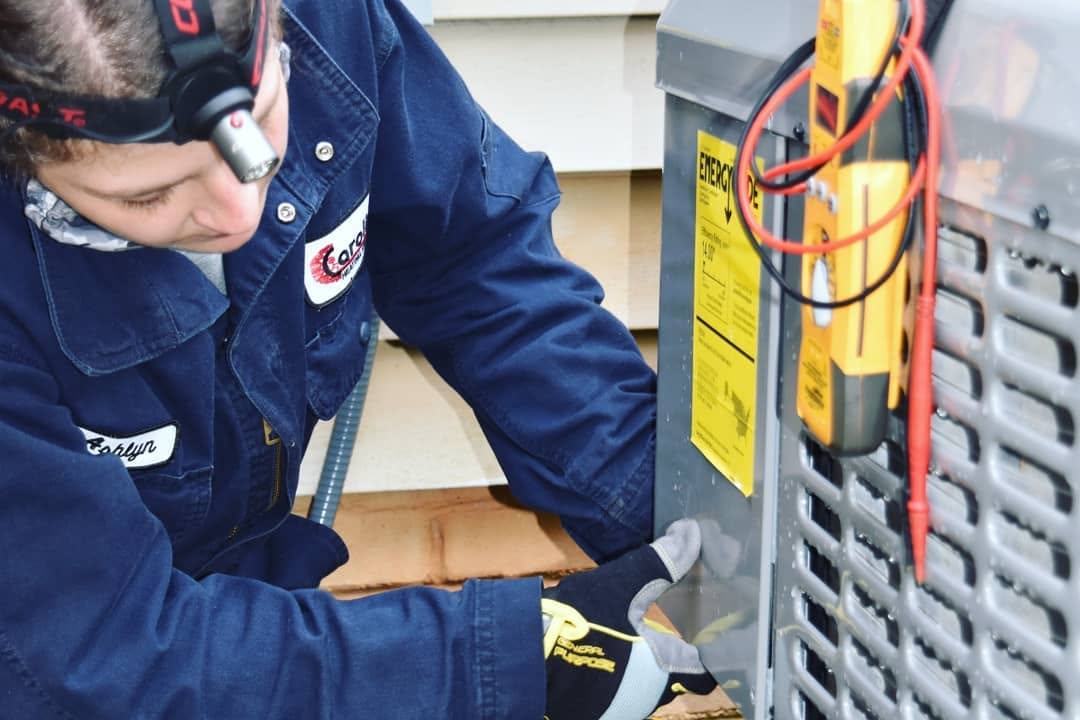
It starts as a connection loosened by a season of vibration or corroded by humidity, and the sign is often nothing at all. What it damages next is itself, because a loose connection builds resistance and heat, and heat loosens and corrodes it further; then the contactor, whose contacts pit and burn; then the capacitor, which weakens under the irregular current; and then the compressor, which starts hard against a weak capacitor every cycle. The chain ends with a burned terminal, a failed capacitor on the first 100-degree heat index, and a compressor that has aged a season for every summer it started hard. A technician stops it at the tune-up by cleaning and tightening every connection and testing the capacitor and contactor under load, which is the least dramatic part of the visit and the one that prevents the most.
4. A blocked condensate drain
It starts as algae in the drain line, which Greenville’s humidity grows every summer, and the sign is water in the pan under the air handler. What it damages next depends on where the air handler sits. In an attic, a full pan overflows into the ceiling below, and the chain runs to drywall, insulation, and the framing beneath. In a closet or a crawl space, it runs to the floor and whatever is stored near it. If the system has a float switch, the switch shuts the system down instead, and the chain becomes a no-cooling call on the hottest day with nothing mechanically wrong. Left to sit, the standing water in the pan grows mold that the blower pushes through the house. A technician stops the chain by clearing and treating the line each spring and confirming the float switch works.
5. Minor mechanical wear
It starts as a bearing wearing in a motor, a fan blade slightly out of balance, or a belt beginning to fray, and the sign is a new sound: a squeal, a rattle, a grind that was not there last season. What it damages next is whatever the worn part touches. A failing bearing takes the motor with it, an unbalanced blower wheel wears its shaft, and a fan blade that finally lets go can damage the coil. Minor wear is the chain with the clearest warning, because the sound arrives weeks before the failure, and a technician stops it by measuring the motor’s current draw and replacing the part while it is still a part.
Why timing matters more in the Upstate
Every chain above runs on hours of operation, and a Greenville cooling system accumulates more of them than a system in a shorter season. A capacitor weakening in May has five months of daily starts ahead of it, a drain clogging in June has the humidity of July and August to work with, and a low charge has a whole summer to cook the compressor. That is why the spring tune-up matters here more than in most places: it catches all five chains at their first link, before the season gives them hours to run.
Stopping the chains before the season
Carolina Heating Service has served Greenville and the Upstate since 1981. A spring maintenance visit checks the charge, changes the filter, cleans and tightens the connections, tests the capacitor and contactor under load, clears the drain, and listens to every motor, and the readings go on a system report card with the visit recorded on video. Members of the Carolina Comfort Club receive two visits a year, member pricing on any repair, and priority service when a chain has already run further than it should have. Schedule online or through the 24/7 website chat, and if the cooling has already stopped, same-day repair service is available by phone.